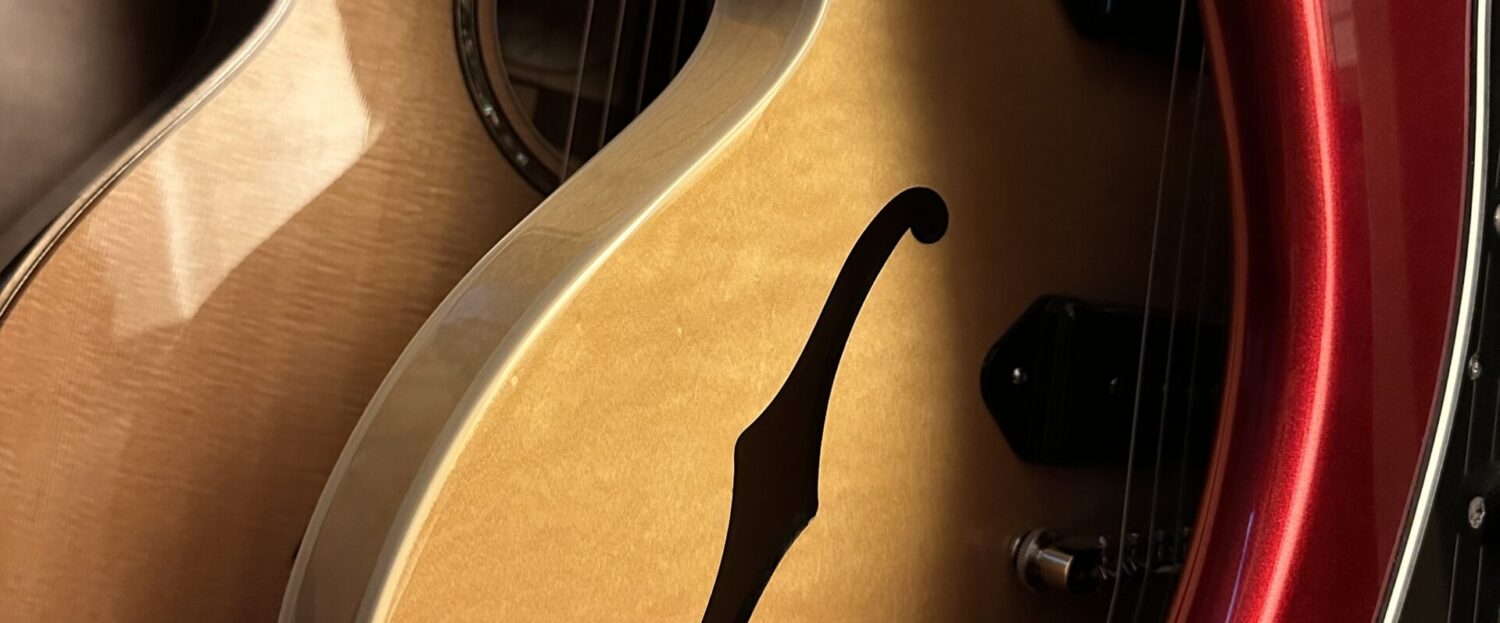
The Guitar Vibrator works by directed acoustic energy (sound) that vibrates your instrument. The instrument resonates with the sound, the strings vibrate, the wood and other materials vibrate, and in time the instrument becomes “played in”. But what if different types of acoustic energy lead to different outcomes?
To accommodate most potential uses, the 34 audio files in the Guitar Vibrator album contain two variables for you to choose from: harmonics content and which pitches to vibrate.
Take a look at the Guitar Vibrator album and you will see these quite clearly. The first part of every track’s name is the harmonics content, while the second part is which pitches to vibrate.
Harmonics Content
Time and experimentation may provide clear answers, but for now it’s a mystery how best to vibrate a guitar. Or more specifically, YOUR guitar. Different guitars may need different sound sources, or different players may want to vibrate their guitar toward a different outcome. Regardless, there are currently four Guitar Vibrator options to choose from:
- “Guitar Break-in”: the sound of a Taylor 812ce run through mild compression
- “Balanced Tone”: a sampled Hammond organ, this sound has some overtones and some pitch shifting
- “Bright Tone”: a Prophet 10 synth, this sound has lots of overtones and more pitch shifting
- “Pure Tone”: an emulated Hammond organ, this sound is almost all fundamental frequency with no pitch shifting
“Guitar Break-in” is the intuitive place to start. What better way to fake one’s way through “playing in a guitar” than by blasting it with guitar sounds?
That said, I suspect that “Balanced Tone” theoretically maximizes the vibration effect. It has less decay, leading to a slightly more consistent transfer of energy from your speakers to your instrument. “Bright Tone” is similar, but distributes the acoustic energy within the sonic spectrum differently to include more high-end. This may lead to a brighter “playing in” effect, or it may just serve to annoy everyone in your household. I’m not entirely sure. 🙂 “Pure Tone” minimizes ambient noise, perhaps maximizing the chance that you’ll actually complete a full cycle of vibrating your guitar.
As you’d expect, the more overtones are present in the sound source, the more the upper harmonics of your guitar will vibrate, possibly “opening up” those frequencies more than if just the lower harmonics are vibrated. So if you’re looking to brighten up your sound, using “Bright Tone” might be the ticket. In contrast, if you think a guitar only needs the fundamental buzzed, stick with “Balanced Tone” or “Pure Tone”.
Or, perhaps you have an all-mahogany or all-koa acoustic and you really want to reinforce its fundamental-focused sound. Then choose “Pure Tone.” Or, if you want to try making it sound like you swapped a spruce top onto your plywood starter dreadnaught, see how far “Bright Tone” will take you.
Two of the sound sources also have a mild tuning shift. Instead of pure pitches on an A=440 Equal Temperament scale, there is a slowly oscillating smush of sound. This is done on purpose, aiming to get the guitar’s wood fully vibrated on the precise pitches AND on the frequencies a little above & below “perfection”. I’m sure your guitar has never gone out of tune mid-set, but I assure you mine has.
My assumption is that “Balanced Tone” is the best option for breaking in a guitar, but your guess may vary. To manage the ambient noise in your household, “Pure Tone” is definitely the best. “Bright Tone” is probably the theoretical best option for opening up a guitar, but speaking from personal experience I am unable to convince my family that the noise is worth it.
All that said, maybe the simplicity of the “Guitar Break-in” sound of another guitar really is the best option.
If you play with these options on your guitars and find interesting results, I’d be glad to hear about it.
Which Pitches to Vibrate – Capo & More
Imagine that you’ve just vibrated your guitar for a week and are amazed to hear its new sound. Wonderful!
…but then you play any note other than an open string (a frequency that wasn’t vibrated for a week) and hear its old dull sound. Doh!
To avoid this from happening, several options are available:
- Open strings (EADGBE)
- Capo 1
- Capo 2
- Capo 3
- Capo 4
- DADGAD
- Single strings
Look in the track titles to find the pitches you’d like your guitar to vibrate at. For the capo tracks, pop on your capo. For DADGAD, tune your guitar to DADGAD.
If your goal is to have all of a guitar’s pitches vibrated, my quick suggestion is to do a full set of capo vibrations. After all five rounds of vibrating, all of a guitar’s pitches will be covered by fundamental and/or overtone frequencies. It might take awhile, but if someone really wants to vibrate a guitar, this is the way.
If you’re looking to just boost the resonant output of a single string on your guitar, choose one of the single string options. I don’t know how well this works, but now it’s easy for you to experiment.